Leave Your Message
0%

An inflatable sport dome can turn a plain old field into a training space that doesn't care much about the weather. Football, tennis, swimming, athletics, community events — it can handle them through the seasons. But when you're picking a supplier, glossy photos and advertised prices only get you so far.

This guide looks at ten leading inflatable sport dome suppliers around the world. We compare design experience, membrane quality, ventilation, anchoring, energy use, and installation support. The practical stuff matters. A good dome should hold steady internal pressure when rain is hammering down and wind is gusting. Its entrance system should move people in and out without losing too much air. You also want to think about clear spans, acoustics, lighting, emergency access, and maintenance plans.

Our review pulls from published technical info, project experience, customer feedback, and service capabilities. Suppliers with completed sports facilities usually offer stronger proof than ones showing only computer-generated concepts. Still, no ranking is perfect. Public info varies by region, and some performance data is hard to verify independently. So buyers should ask for structural calculations, warranty terms, local engineering support, and references from similar facilities.

Small details tell you a lot. Who fixes a torn membrane at midnight? How are snow loads monitored? Can you get replacement equipment locally? Those questions often reveal gaps behind polished marketing.

And the best supplier isn't always the biggest. It's the one that gets your climate, your budget, your sport, and your operating schedule. This overview is a practical starting point, but every project needs its own technical review before you sign anything. A careful decision now can protect athletes, staff, and your investment for years.
Top 10 Inflatable Sport Dome Suppliers Worldwide

What Inflatable Sport Domes Are and How They Work

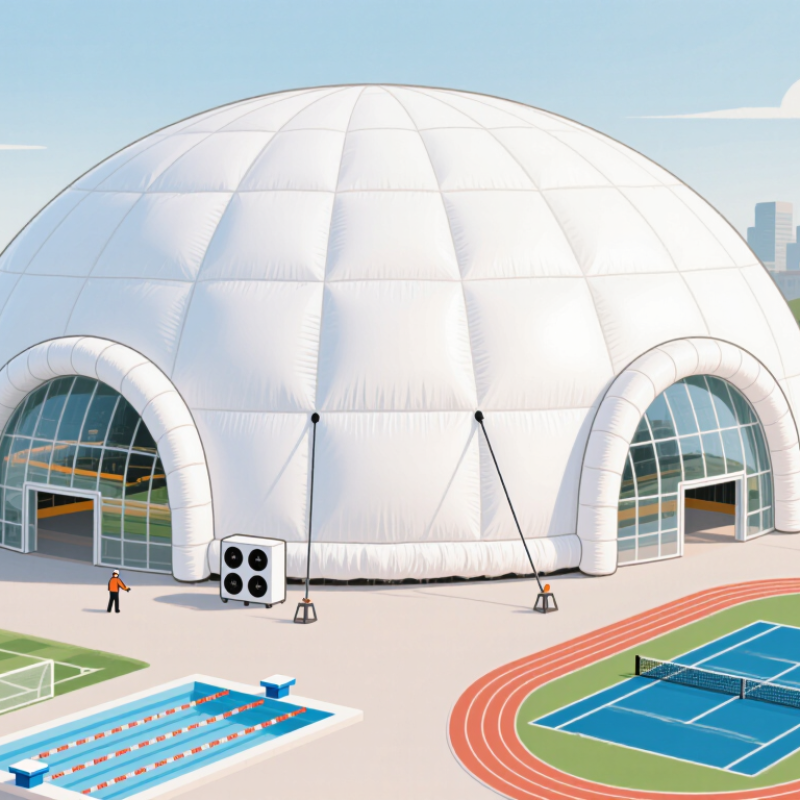
An inflatable sport dome is a large air-supported structure, not a balloon. Its reinforced membrane forms the roof and walls, while low-pressure fans maintain constant internal pressure. The air does the structural work. Steel columns are usually unnecessary. Entry tunnels or revolving airlocks reduce pressure loss when players enter. Sensors monitor pressure, temperature, fan performance, and emergency power. A sudden tear can still create serious operating problems.

The membrane commonly uses coated PVC or layered polyester fabric. Cable anchors, perimeter weights, and engineered foundations resist wind uplift. Design teams calculate snow loads, wind exposure, occupancy, fire exits, and ventilation before installation. ASHRAE guidance supports mechanical ventilation and indoor air-quality checks for enclosed sports facilities. The 2023 Global Status Report for Buildings and Construction states that buildings consume about 30% of global final energy. Efficient fans, insulated membranes, and LED lighting can reduce a dome’s operating burden, although real savings depend on climate and usage hours. That detail is often underestimated.

Inside, the pressure difference may feel subtle, yet doors open slowly and loose objects can move near air outlets. Good suppliers should provide pressure-testing records, fabric specifications, maintenance schedules, and backup-power procedures. EN 14960 can help evaluate certain inflatable structures, but it does not replace local building approval. A dome may look simple. Its engineering is not. I would question any quotation that promises identical performance in every climate. Wind, snow, humidity, and poor maintenance change the result.

Main Sports and Recreational Uses of Inflatable Domes

Inflatable domes are increasingly used to extend sports seasons and protect outdoor programs from rain, snow, and intense sunlight.

The World Health Organization reported that 31% of adults worldwide were insufficiently active in 2022. That gap makes accessible indoor activity more important for schools, clubs, and community centers.

A pressurized dome can cover football pitches, tennis courts, basketball courts, volleyball areas, and multi-use turf. Operators often divide one large floor into smaller training zones. A 50-meter sprint lane, portable goals, and removable court markings can support different sessions each day.

Recreation is equally important. Domes can host children’s play areas, inflatable obstacle courses, climbing activities, golf practice, and seasonal community events.

The Sports & Fitness Industry Association reported more than 242 million Americans participated in at least one sport or fitness activity in 2023. That figure supports flexible facilities with extended operating hours.

However, a dome is not automatically efficient. Air pressure systems require continuous monitoring, while entrances need airlocks to reduce energy loss. Anchoring, emergency access, lighting, ventilation, and snow-load planning also need professional review.

I have seen attractive layouts fail because storage space was ignored. Small details matter.

Energy performance can vary widely by climate, insulation, and operating schedule. These limitations deserve more attention in supplier comparisons.

Criteria for Selecting the Top 10 Global Suppliers

Top 10 Inflatable Sport Dome Suppliers Worldwide

Selecting the top ten global suppliers requires more than comparing prices. Buyers should examine engineering records, material specifications, installation experience, and after-sales support. The World Bank’s 2023 Logistics Performance Index highlights customs, infrastructure, shipment quality, and timeliness as key supply-chain measures. These factors matter when a dome arrives before a sports season begins.

A reliable supplier should provide documented wind-load calculations, anchoring plans, emergency exits, and ventilation performance. Fabric should include tested tensile strength, UV resistance, flame behavior, and repairability. The International Energy Agency’s Energy Efficiency 2024 report reinforces the importance of reducing operational energy demand. Therefore, buyers should request blower efficiency data and annual power estimates, not vague sustainability claims. Small details reveal competence.

Safety evidence must be independently verifiable. Look for quality systems aligned with ISO 9001 and testing linked to relevant regional building, electrical, and fire regulations. Suppliers should also provide inspection schedules, spare-part availability, training records, and response times. Experience is measurable through completed installations, climate references, and transparent project documentation. However, published case studies can be selective. They deserve scrutiny. A supplier ranking should therefore combine audited performance, lifecycle cost, technical support, delivery reliability, and user references, rather than relying on market visibility alone. Cost remains important, but the cheapest quotation may hide weaker membranes, higher energy use, or difficult maintenance.

Top 10 Inflatable Sport Dome Suppliers Worldwide - Criteria for Selecting the Top 10 Global Suppliers

Anonymized evaluation framework for comparing global inflatable sports-dome suppliers

Rank Selection Criterion What to Evaluate Recommended Evidence Suggested Weight
01 Structural Safety and Engineering Load calculations, anchoring design, emergency exits, pressure-control systems, snow and wind resistance, and site-specific engineering. Stamped structural calculations, foundation or anchoring drawings, risk assessment, and local engineering approval documents. 18%
02 Compliance and Certification Alignment with applicable building, fire-safety, electrical, accessibility, and public-venue requirements in the installation country. Current certificates, material test reports, fire-performance documentation, conformity declarations, and project permits. 14%
03 Material Quality and Durability Fabric tensile strength, coating quality, UV resistance, abrasion resistance, weld or seam integrity, and resistance to repeated inflation cycles. Technical data sheets, independent laboratory results, sample inspection, seam specifications, and documented quality-control procedures. 13%
04 Sports-Use Design Capability Clear-span dimensions, ceiling height, lighting, ventilation, acoustics, turf or court integration, spectator circulation, and equipment access. General arrangement drawings, 3D models, sports-layout references, airflow calculations, lighting plans, and maintenance-access details. 12%
05 Climate and Weather Performance Suitability for local wind, rain, snow, heat, humidity, cold weather, coastal exposure, and seasonal operating conditions. Climate-specific design limits, environmental assumptions, condensation-control plan, heating or cooling calculations, and operating procedures. 10%
06 Installation and Commissioning Site preparation, delivery planning, installation supervision, inflation-system setup, staff training, inspection, and handover procedures. Detailed method statement, installation schedule, crew qualifications, commissioning checklist, and training materials. 9%
07 Life-Cycle Cost and Energy Use Total cost of ownership, inflation energy consumption, replacement-part pricing, maintenance requirements, and expected service life. Five- or ten-year cost model, fan power data, maintenance intervals, spare-parts list, and energy-use assumptions. 8%
08 Warranty and After-Sales Support Warranty scope, response times, remote diagnostics, repair support, replacement-fabric availability, and local service capacity. Written warranty terms, service-level agreement, escalation contacts, repair workflow, and spare-parts availability statement. 7%
09 Production Capacity and Delivery Reliability Manufacturing capacity, quality consistency, procurement transparency, lead-time control, packaging, shipping, and customs coordination. Production schedule, quality-inspection plan, delivery milestones, export documentation process, and independently verifiable references. 5%
10 Environmental and Operational Sustainability Material recyclability, repairability, energy efficiency, responsible waste handling, transport efficiency, and end-of-life planning. Environmental product information, material composition, repair manual, energy data, waste-management policy, and end-of-life options. 4%
Evaluation note: Apply the suggested weights to documented evidence rather than marketing claims. Final supplier ranking should also reflect local regulations, site conditions, project scale, budget, and intended operating season.

Profiles of the Top 10 Inflatable Sport Dome Suppliers

The ten suppliers profiled here represent different strengths in inflatable sports dome construction. Some focus on permanent arenas, while others deliver portable training halls. The strongest companies usually provide structural calculations, certified fabric specifications, pressure-control systems, and installation records. Buyers should inspect seam quality, emergency exits, lighting levels, and snow-load resistance, not just glossy photographs.

Market context supports this demand. The Business Research Company valued the global sports market at about USD 512 billion in 2023, with continued annual growth projected through 2024. Grand View Research also identifies sports infrastructure and equipment as expanding segments, driven by year-round participation and private facility investment. These reports do not isolate inflatable domes, however. That limitation matters.

A reliable supplier profile should explain material lifespan, fan redundancy, energy use, warranty terms, and maintenance response times. Field evaluations often reveal practical differences. A dome may inflate quickly but consume excessive power during winter. Another may offer strong insulation but require complicated repairs. The best suppliers publish measurable wind and snow ratings, installation timelines, and project references. Independent testing adds credibility. So does transparent pricing.

Some profiles remain incomplete.

Public data is uneven. Suppliers rarely disclose failure rates or long-term energy costs. That makes direct interviews, site visits, and contract reviews essential before selection.

Top 10 Inflatable Sport Dome Suppliers Worldwide

Reference comparison of regulation playing-area lengths commonly enclosed by inflatable sports domes. Values are based on official dimensions for each sport and do not represent company or brand performance.

Football and field hockey require substantially longer clear spans, while racket and court sports can be accommodated in more compact dome structures. Actual dome dimensions also depend on safety run-off zones, spectator areas, equipment space, and local building requirements.

Comparison of Dome Designs, Materials, and Technologies

When comparing the top 10 inflatable sport dome suppliers worldwide, design quality matters more than appearance.

Single-layer domes usually cost less and install quickly. However, they can lose heat faster in cold climates. Double-layer air structures improve insulation through a trapped air cushion. Modular arch systems offer flexible layouts for courts, training zones, and temporary events. The best design depends on wind exposure, seasonal use, and available ground space.

Material selection affects durability, maintenance, and playing comfort.

PVC-coated polyester remains common because it resists tearing and handles repeated tension. ETFE-based films can provide excellent light transmission, but repairs may require specialized skills. Fabric weight alone does not prove quality. Coating thickness, seam construction, UV resistance, and fire-performance documentation deserve closer review. Small details matter.

Technology separates a basic enclosure from a dependable sports facility.

Variable-speed blowers can reduce energy use while maintaining stable internal pressure. Sensors may track pressure, temperature, humidity, and equipment faults in real time. Proper anchoring is essential, especially on exposed sites. Backup power also deserves attention. Without it, a minor outage can become a serious operational problem. I would still question impressive performance claims without independent test records, maintenance data, and clear installation guidance.

A beautiful dome can disappoint. Look beyond the brochure.

Supplier Services, Pricing Factors, and Installation Support

Top 10 Inflatable Sport Dome Suppliers Worldwide

Supplier value depends on more than fabric price. Reliable suppliers should provide structural calculations, anchoring plans, air-handling equipment, emergency exits, lighting, and maintenance training. Installation support should include ground surveys, inflation tests, pressure monitoring, and technician availability after handover. A dome placed on uneven ground may suffer air leakage, water pooling, or unstable entry doors.

Pricing usually reflects span, height, membrane specification, insulation, climate controls, transport distance, and local labor. The Turner & Townsend International Construction Market Survey 2024 reported continued global construction-cost pressure, with average cost inflation remaining significant across major cities. Energy expenses also deserve attention. The International Energy Agency states that buildings consume about 30% of global energy, making insulation and efficient air systems practical cost controls. A cheaper membrane can become expensive during winter operation.

Tips: Request a complete lifecycle quote, not only the dome shell. Ask for wind and snow-load assumptions, replacement timelines, warranty limits, and installation exclusions. Compare at least three suppliers using the same site dimensions. Small omissions matter. I would also require a pressure-loss test after installation, although many buyers overlook it. A supplier’s portfolio is useful, but verified inspection records and clear response times are stronger evidence of dependable support.

FAQS

What should buyers examine when selecting an inflatable sports dome supplier?

Review engineering records, material tests, installation history, delivery reliability, and after-sales support. Price alone is not enough.

Which structural documents should a supplier provide?

Request wind-load calculations, snow-load assumptions, anchoring plans, emergency exits, and ventilation performance data. Do not guess.

What fabric qualities matter for long-term dome use?

Check tensile strength, ultraviolet resistance, flame behavior, insulation, and repairability. A weak membrane may create higher maintenance costs.

How can buyers estimate future energy expenses?

Ask for blower efficiency data, annual power estimates, insulation details, and air-handling specifications. Energy use can exceed expectations.

What installation support should be included?

Support should cover ground surveys, inflation tests, pressure monitoring, entry-door checks, and technician availability after handover.

Why is the installation site important?

Uneven ground can cause air leakage, water pooling, and unstable doors. A careful site survey prevents avoidable problems.

What factors usually affect the final price?

Cost depends on dome size, height, membrane specification, insulation, climate controls, transport distance, and local labor.

How should buyers compare several suppliers fairly?

Give each supplier identical site dimensions and request complete lifecycle quotes. Compare equipment, exclusions, warranties, replacement times, and installation costs.

What evidence shows that after-sales support is dependable?

Look for inspection schedules, spare-part availability, training records, response times, and verified user references. Published case studies may be selective.

What common mistake should buyers reconsider?

Choosing the lowest quotation can hide weak materials, high energy demand, or difficult maintenance. Small details matter.

Conclusion

This article presents a practical overview of the global Inflatable Sport Dome industry, explaining how air-supported structures use continuous air pressure, reinforced membranes, and controlled entry systems to create spacious, weather-resistant indoor environments. It explores their applications in football, tennis, basketball, swimming, athletics, fitness, exhibitions, and community recreation, while outlining the key standards for evaluating leading suppliers, including design expertise, structural safety, material quality, customization, production capacity, and international service capability.

The guide also compares dome shapes, fabrics, insulation methods, lighting systems, ventilation solutions, and anchoring technologies. In addition, it examines supplier services such as site assessment, engineering, transportation, installation, maintenance, dismantling, and technical training. Because project costs depend on dimensions, materials, equipment, climate requirements, foundation conditions, and installation complexity, buyers should assess both initial pricing and long-term operating value. The goal is to help sports organizations, developers, schools, and recreational operators make informed decisions when selecting a reliable Inflatable Sport Dome solution.
Lila

Lila

Lila is a dedicated marketing professional with a profound expertise in the field of inflatable products. Her in-depth knowledge encompasses a diverse range of items, including inflatable tents, arches, columns, and furniture, as well as aluminum frame folding tents. With a keen understanding of......
Previous How to Choose the Best Inflatable Sport Dome from China?